
Where the phrase comes from
The Party Wall etc. Act 1996 applies across England and Wales; it does not apply in Scotland or Northern Ireland. It gives a building owner (the person who wants to do the work) rights to carry out certain work to a party wall, at the boundary, or close to a neighbour’s foundations. In return the building owner must give the adjoining owner advance written notice and follow a set procedure. The Act talks about notices, consent, disputes and awards. “Party wall agreement” is the phrase homeowners, builders, solicitors and mortgage lenders use for the end result: the document that shows the neighbour’s position has been dealt with.
The Act is a procedural statute. It does not stop you building, and it does not let a neighbour veto work you are entitled to do. What it does is make sure the neighbour knows what is coming, has a say in how and when it is done, and has a route to get any damage put right.
The two forms a party wall agreement can take
| Route | What it is | When it happens |
|---|---|---|
| Written consent | The adjoining owner signs to say they agree to the works in the notice. Best done with a Schedule of Condition recording their property first. | The neighbour agrees in writing, normally within 14 days of the notice. |
| Party Wall Award | A legal document made by an Agreed Surveyor, or by two surveyors (with a third in reserve), settling the right to do the work, how and when it is done, and costs (s.10(12)). | The neighbour dissents, or says nothing within 14 days so a dispute is deemed to arise (s.5, s.6(7)). |
Consent is quicker and cheaper. An Award is more formal and binding on both sides, and can be appealed to the county court only within 14 days of service (s.10(16)–(17)). Neither is “better” in the abstract: the right route depends on the work and the neighbour.
Which works need one?
Three groups of work are covered. We have separate guides on each.
- Section 1: new walls at the boundary. Building a new wall on or astride the “line of junction”, such as the flank wall of an extension or a new masonry garden wall. One month’s notice. See section 1.
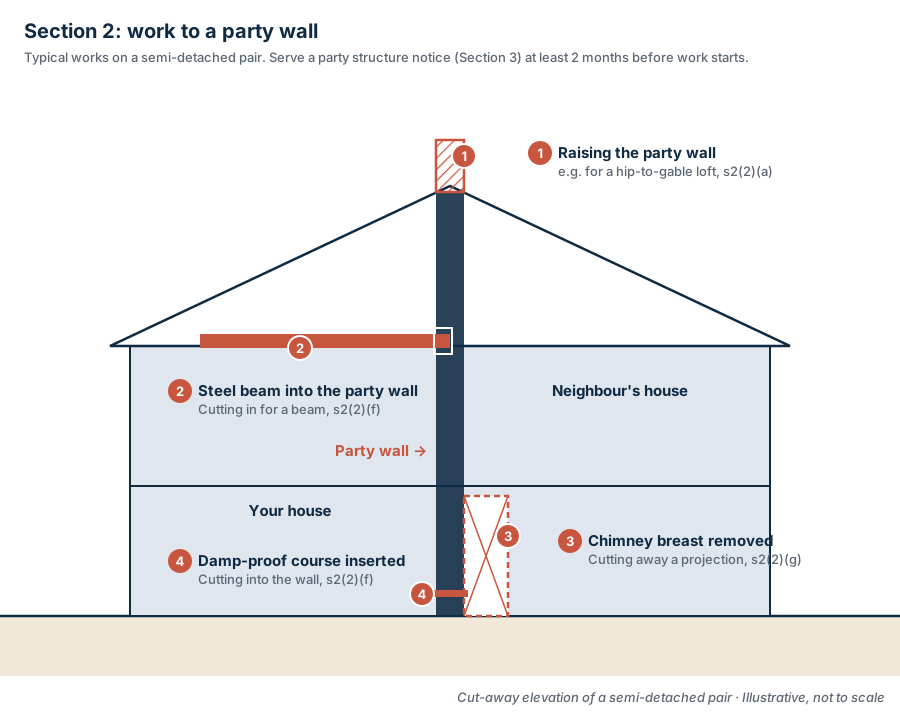
- Section 2: work to an existing party wall or party structure. Cutting in for steel beams, raising the wall for a loft, removing a chimney breast, underpinning, inserting a damp-proof course, demolishing and rebuilding. Served as a party structure notice under section 3, with two months’ notice. See section 2 rights.
- Section 6: excavation near a neighbour’s building. Digging within 3 metres of their building and deeper than its foundations, or within 6 metres where the dig crosses a 45° line down from their foundations. One month’s notice. See our section 6 guide.
The government’s explanatory booklet says minor work such as drilling to fix shelves or kitchen units, adding or replacing electrical sockets with minor chases for wiring, or replastering is not notifiable. Cutting pockets for beams or removing brickwork is a different matter. If you are not sure, use our 1-minute checker or ask us.
Common projects and what they usually trigger
| Project | Usual sections | Minimum notice |
|---|---|---|
| Loft conversion on a terrace or semi | s.2 (beams, raising, chimney breasts) | 2 months |
| Kitchen knock-through with a beam on the party wall | s.2(2)(f) | 2 months |
| Single-storey rear extension | s.6, often s.1, sometimes s.2 | 1 month (2 if s.2 work) |
| Chimney breast removal | s.2(2)(g) | 2 months |
| Basement or underpinning | s.2(2)(a), s.6 | 2 months |
| New masonry garden wall on the boundary | s.1 | 1 month |
These are typical patterns, not rules: the drawings decide. Detailed guides: loft conversions, rear and side-return extensions.
Who has to be notified
Notice goes to every owner of each adjoining property, and “owner” is wider than people expect (s.20). It includes the freeholder, a leaseholder whose lease is for more than a year, and someone under contract to buy. A house split into flats can have a freeholder and several leaseholders, all entitled to notice. A tenant on a short let is an occupier, not an owner, but still has rights, for example to notice before anyone enters under s.8. Check the Land Registry title rather than assuming the person living next door is the only owner.
How the process works
- Notice. You, or a surveyor for you, serve the right notice on every adjoining owner, with the required details and drawings. Notices can be served by hand, by post, or by email if the recipient has agreed to that (s.15).
- Response. The neighbour has 14 days to respond to a section 3 or section 6 notice. They can consent, consent subject to a Schedule of Condition, or dissent. Silence counts as dissent.
- Surveyors, if there is a dispute. The owners either agree on one Agreed Surveyor or each appoint their own, and those two select a third (s.10(1)). If a neighbour will not appoint, you can appoint for them after a 10-day request (s.10(4)).
- Schedule of Condition and Award. The surveyor(s) record the neighbour’s property, check the drawings and make an Award covering what can be done, how, when and who pays.
- Work starts. Once the notice period has run (or earlier with written agreement) and, where needed, the Award is served. The notice lapses if work has not started within 12 months (s.3(2)(b), s.6(8)).
What the neighbour can and cannot do
An adjoining owner can ask questions, require a Schedule of Condition through the surveyors, ask for the work to be done at reasonable times and in a reasonable way, require security for expenses on more intrusive work (s.12), serve a counter notice asking for extra works for their own benefit (s.4), and be compensated for any loss or damage (s.7(2)). They cannot stop work that the building owner is entitled to do, and they cannot use the Act to settle a boundary dispute or reopen planning permission.
Worked example: a kitchen knock-through in a semi
Illustrative only. Priya wants to remove the wall between her kitchen and dining room in a 1930s semi. Her engineer designs a steel beam with one end bearing in the party wall on a padstone. That is cutting into a party structure under s.2(2)(f), so she serves a party structure notice two months before her builder’s start date. Her neighbour consents but asks for a Schedule of Condition first. The surveyor photographs the neighbour’s kitchen and back room, the consent is signed with the Schedule attached, and the builder starts on the planned date. That signed consent plus Schedule is her “party wall agreement”. Had the neighbour dissented, the same Schedule would have formed part of an Award instead.
What happens if you skip it
There is no criminal offence in failing to serve notice, but the neighbour can apply to court for an injunction stopping the work until the Act is followed, and starting without notice is often described as “no notice, no Act”. That leaves you in a worse position, because you have not followed the due process set out in the Act of Parliament that specifically covers notifiable works: you lose the Act’s protections and dispute-resolution route, and risk an injunction or a damages claim. You also lose the protection of the Act’s procedure if damage is later alleged, and the lack of an agreement can come up when you sell. See starting work without notice.
What it costs with us
| Service | Fee + VAT | inc VAT |
|---|---|---|
| Party wall notices (all your neighbours) | £150 | £180 |
| Notices + one Schedule of Condition | £499 | £598.80 |
| Each extra Schedule of Condition | £399 | £478.80 |
| Standalone Schedule of Condition | £450 | £540 |
| Party Wall Award | £400 | £480 |
| Full package (notices, Schedule, Award) | £899 | £1,078.80 |
| Full package, London | £999 | £1,198.80 |
| Agreed Surveyor supplement | £0 |
Domestic extensions and loft conversions. Fixed fees, invoiced on completion; we take enquiries only, with no online payment. If your neighbour appoints their own surveyor, the building owner normally pays that surveyor’s reasonable fees as well (s.10(13)), and those are set by that surveyor, not by us.
Most building owners need notices plus a Schedule of Condition (£499 + VAT) where the neighbour consents, or the full package (£899 + VAT, £999 in London) where there is a dispute and we act as Agreed Surveyor.
Sources and further reading
- Party Wall etc. Act 1996, section 1: New building on line of junction (legislation.gov.uk)
- Party Wall etc. Act 1996, section 2: Repair etc. of party wall: rights of owner (legislation.gov.uk)
- Party Wall etc. Act 1996, section 3: Party structure notices (legislation.gov.uk)
- Party Wall etc. Act 1996, section 5: Disputes arising under sections 3 and 4 (legislation.gov.uk)
- Party Wall etc. Act 1996, section 6: Adjacent excavation and construction (legislation.gov.uk)
- Party Wall etc. Act 1996, section 7: Compensation etc. (legislation.gov.uk)
- Party Wall etc. Act 1996, section 10: Resolution of disputes (legislation.gov.uk)
- Party Wall etc. Act 1996, section 15: Service of notices etc. (legislation.gov.uk)
- Party Wall etc. Act 1996, section 20: Interpretation (legislation.gov.uk)
- GOV.UK: The Party Wall etc. Act 1996 explanatory booklet
- GOV.UK: Party walls and building work
- Faculty of Party Wall Surveyors (FPWS)
Section references are to the Party Wall etc. Act 1996 as it applies in England and Wales, checked against legislation.gov.uk. This guide is general professional guidance, not legal advice; every project should be assessed on its own drawings.
- Party wall notices for building owners
- Fixed fees: party wall agreement cost
- Do I need a party wall agreement? (1-minute check)
Areas we cover include Party Wall Agreement London · Party Wall Agreement Essex · Party Wall Agreement Kent and more.
Sources: Party Wall etc. Act 1996 (legislation.gov.uk) · The Party Wall etc. Act 1996: explanatory booklet (GOV.UK) · Faculty of Party Wall Surveyors (FPWS). Last reviewed 27 October 2026. General guidance on the law in England and Wales, not legal advice.