
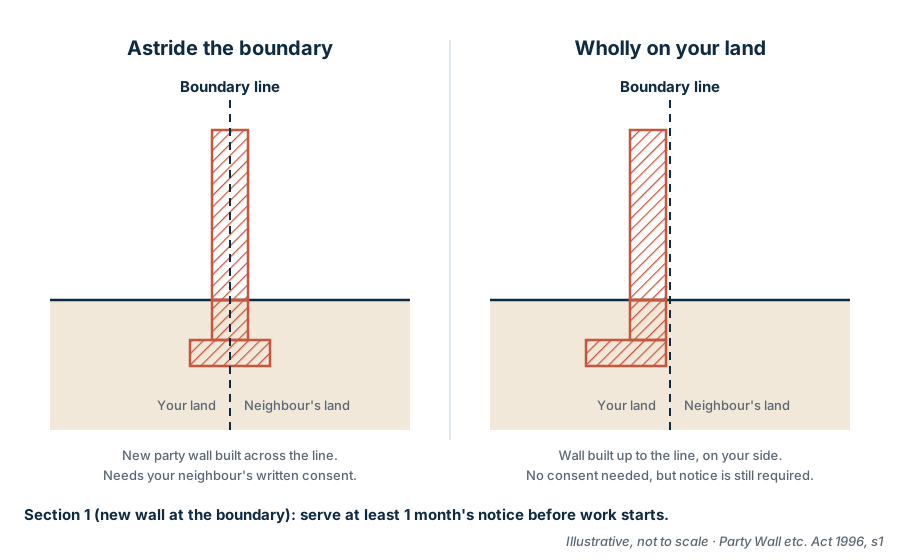
When section 1 applies
Section 1 applies where the lands of different owners adjoin and are either not built on at the line of junction, or built on only to the extent of a boundary wall that is not a party fence wall or the external wall of a building (s.1(1)). In plain terms: the boundary is open, or there is a fence, or a wall that sits wholly on one side. If there is already a party wall or party fence wall there, you are dealing with section 2 instead.
The “line of junction” is the legal boundary between the two properties. Section 1 does not decide where that line is; if the position of the boundary is in dispute, sort that out first.
The two kinds of section 1 notice
| Wall astride the boundary (s.1(2)) | Wall wholly on your land (s.1(5)) | |
|---|---|---|
| Notice period | At least one month | At least one month |
| Neighbour’s consent needed? | Yes, in writing within 14 days (s.1(3)–(4)) | No, but notice is still required |
| Who pays for the wall? | Shared in proportion to use, if they consent (s.1(3)(b)) | You |
| If no consent | Build wholly on your own land at your expense (s.1(4)) | N/A |
| Projecting footings under their land | N/A | Allowed where necessary, at your expense (s.1(6)) |
Note the difference from section 3 and section 6 notices: for a section 1 wall astride the boundary, silence is not “deemed dissent” leading to surveyors. It simply means you have no consent, so the wall must be built wholly on your land. Any later dispute under section 1, for example about damage or the footings, is settled under section 10 (s.1(8)).
Foundations under the neighbour’s land
Where you build wholly on your own land, section 1(6) gives a right to place projecting footings and foundations below the level of the neighbour’s land, where necessary for the wall, at your expense. The right runs from one month after the notice is served until twelve months after service. You must compensate the neighbour and any occupier for damage caused by building the wall or placing the footings (s.1(7)).
Special foundations, meaning foundations using an assemblage of beams or rods to distribute load, which in practice means reinforced concrete, can only be placed on the neighbour’s land with their written consent (s.7(4), s.20). Most modern strip and trench-fill foundations for extensions contain reinforcement only where the engineer specifies it, so check your drawings: if the footing is reinforced and projects, you need consent or a redesign, often an eccentric or cantilevered footing kept within your own boundary.
Typical projects that need a section 1 notice
- The flank wall of a side-return or rear extension built right up to the boundary.
- A new masonry garden wall on the boundary.
- A new detached garage or garden room with a wall on the boundary.
- A new house in a gap site where the flank wall is built at the line of junction.
A wall built a little way inside your boundary, leaving a gap, is not “on the line of junction” and section 1 does not apply, although section 6 may still apply to its foundations.
Often combined with section 6, sometimes with section 2
New walls need foundations, and if you dig within 3 metres of the neighbour’s building and deeper than its foundations, a section 6 notice is also needed (s.6(1)), with plans and sections. If the new wall connects to, or is built onto, an existing party wall or party fence wall, section 2 work arises too, needing a party structure notice with two months’ notice. One combined set of notices can cover all of these, as long as each section’s requirements are met. See our section 6 guide and extensions guide.
What the notice must say
A section 1 notice “indicates his desire to build and describes the intended wall”. In practice we include: the building owner’s name and address; the address of the works; whether the wall is astride or wholly on your land; its length, height, thickness and materials; the foundation design and whether footings will project under the neighbour’s land; the intended start date; and drawings. A clear notice avoids the neighbour dissenting simply because they do not understand what is proposed.
Worked example: a side-return extension
Illustrative only. Hannah’s Victorian terrace has a narrow side return running alongside her neighbour’s garden, separated by a low timber fence. She plans to infill the side return with a new brick flank wall on the boundary. There is no existing wall at the line of junction, so section 1 applies. She asks her neighbour whether they would like the wall built astride the boundary as a shared party wall; they prefer not, so she serves a section 1(5) notice to build wholly on her land. The engineer’s trench-fill foundation would project slightly under the neighbour’s garden, which s.1(6) allows. The trench is also within 3 m of the neighbour’s back addition and deeper than its foundations, so a section 6 notice is served at the same time. The neighbour dissents on the section 6 notice and the Agreed Surveyor makes an Award covering both.
Practical points from site
- Set out the boundary accurately before you serve; your builder should not be guessing.
- Agree how the old fence will be removed and the gap secured during the works.
- Think about the neighbour’s side of the wall: finish, pointing, drainage of rainwater and gutter overhang. Gutters and eaves overhanging the neighbour’s land are a common source of complaint, and the Act does not give you a right to oversail.
- Access to build or point the neighbour’s face of the wall may need entry under s.8 with 14 days’ notice.
Costs
Our fixed fees for domestic work (all + VAT): party wall notices £150 (all your neighbours); notices plus a Schedule of Condition £499 (each extra Schedule £399); Party Wall Award £400; full package of notices, Schedule and Award £899 (£999 in London). Acting as Agreed Surveyor normally carries a £50 supplement, currently waived. If your neighbour appoints their own surveyor, you will normally also pay that surveyor’s reasonable fees (s.10(13)); those are set by them, not us. See our prices.
Sources and further reading
- Party Wall etc. Act 1996, section 1: New building on line of junction (legislation.gov.uk)
- Party Wall etc. Act 1996, section 6: Adjacent excavation and construction (legislation.gov.uk)
- Party Wall etc. Act 1996, section 7: Compensation etc. (legislation.gov.uk)
- Party Wall etc. Act 1996, section 8: Rights of entry (legislation.gov.uk)
- Party Wall etc. Act 1996, section 10: Resolution of disputes (legislation.gov.uk)
- Party Wall etc. Act 1996, section 20: Interpretation (legislation.gov.uk)
- GOV.UK: The Party Wall etc. Act 1996 explanatory booklet
- GOV.UK: Party walls and building work
Section references are to the Party Wall etc. Act 1996 as it applies in England and Wales, checked against legislation.gov.uk. This guide is general professional guidance, not legal advice; every project should be assessed on its own drawings.
- Party wall notices for building owners
- Fixed fees: party wall agreement cost
- Do I need a party wall agreement? (1-minute check)
Areas we cover include Party Wall Agreement Kent · Party Wall Agreement Hertfordshire · Party Wall Agreement Surrey and more.
Sources: Party Wall etc. Act 1996 (legislation.gov.uk) · The Party Wall etc. Act 1996: explanatory booklet (GOV.UK). Last reviewed 27 October 2026. General guidance on the law in England and Wales, not legal advice.