Skip to content
Party wall agreements & notices · Fixed fees, invoiced on completionFree initial advice: 08000 487897 · hello@partywall-agreement.co.uk
Home › Type of works
Service guide

Which works need a party wall agreement?

The Party Wall etc. Act 1996 covers three kinds of work: building a new wall on the boundary (Section 1), work to an existing party wall (Section 2, served under a Section 3 notice) and excavating near a neighbour’s building (Section 6). The last is often overlooked by owners planning to extend.

Section 1: a new wall on the boundary

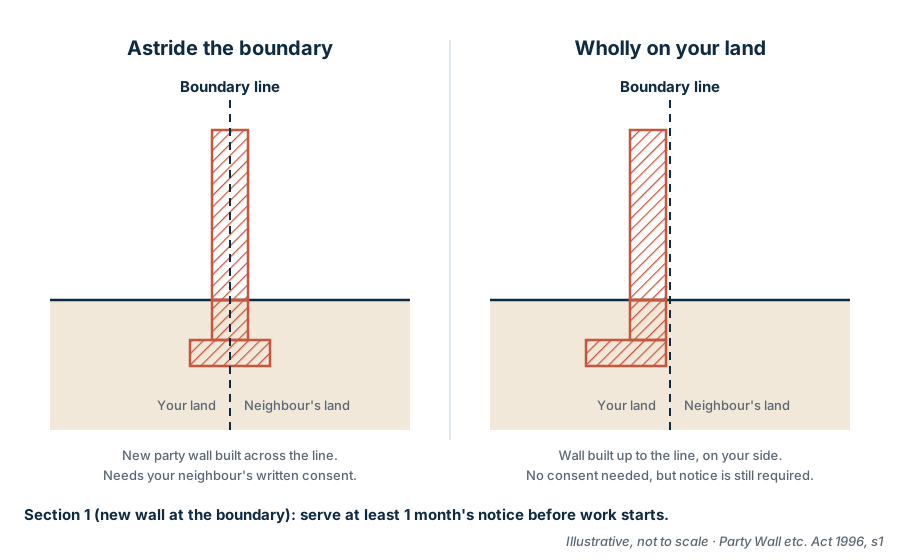
If you build a new wall on or astride the boundary line, you must serve a Section 1 line of junction notice at least 1 month before work starts. A wall astride the boundary needs your neighbour’s written consent; a wall wholly on your land still needs notice.
Section 1 new wall on the boundary diagram
Section 1: new wall at the boundary. Illustrative, not to scale.

Section 2 works: work to a party wall

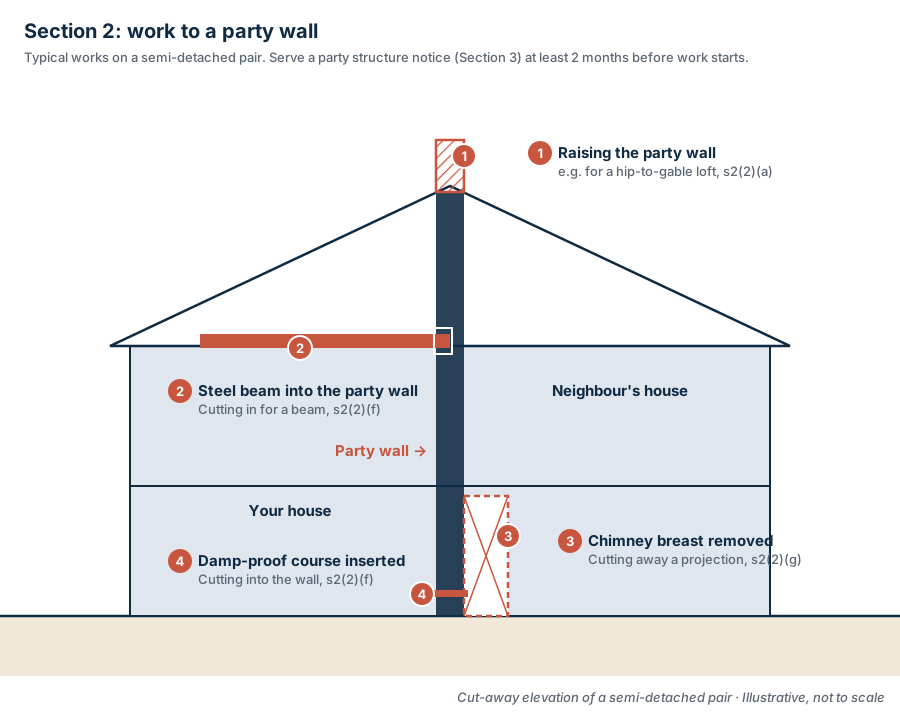
Typical works on a semi-detached or terraced house include raising the party wall (for example for a hip-to-gable loft), cutting in for a steel beam, removing a chimney breast and inserting a damp-proof course. Serve a party structure notice (Section 3) at least 2 months before work starts.
Section 2 party wall works on a semi-detached pair
Section 2 works, served under a Section 3 notice. Illustrative, not to scale.

Section 6: excavating near a neighbour

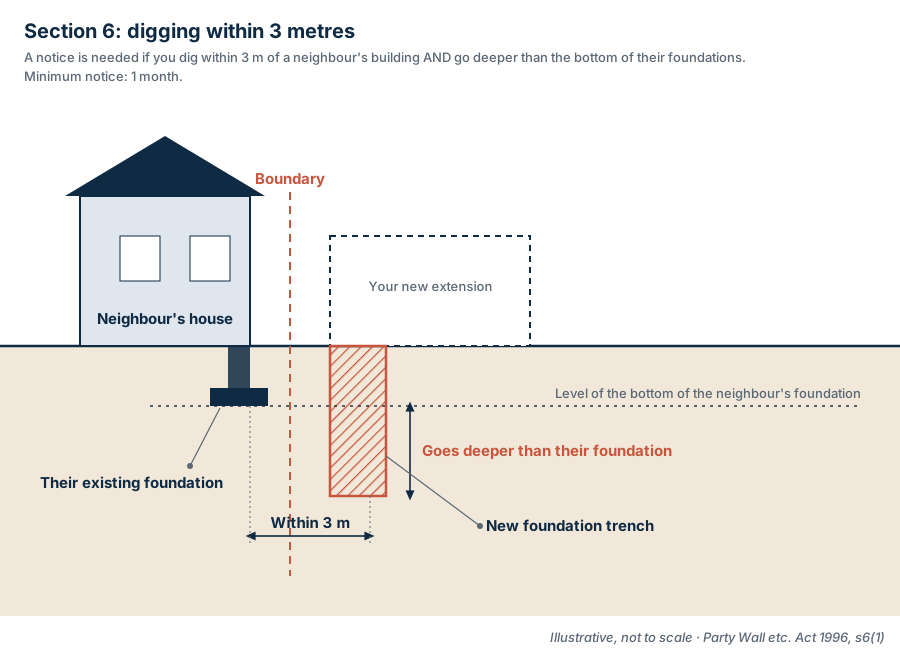
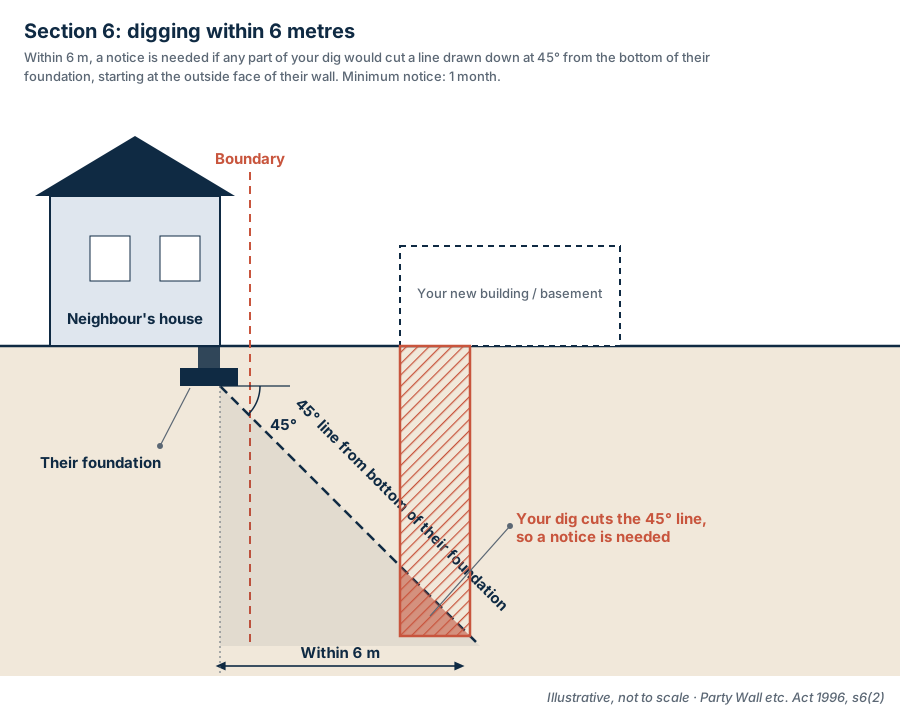
Serve a Section 6 notice at least 1 month before you dig within 3 metres of a neighbour’s building and deeper than their foundations, or within 6 metres where your dig would cut a 45° line from the bottom of their foundations. Read the Section 6 guide →
Section 6 within 3 metres
Within 3 m and deeper than their foundation.
Section 6 within 6 metres 45 degree line
Within 6 m and cutting the 45° line.
Not sure if your project is caught? Take the 1-minute check or call free on 08000 487897.

Source: Party Wall etc. Act 1996, ss.1, 2, 3 and 6 (legislation.gov.uk). General guidance only, not legal advice.
How it works

From notice to agreement in four steps

The Building Owner (the person doing the works) has to serve notice and get consent from each Adjoining Owner before work starts.

Talk to your neighbour

We always advise speaking to the Adjoining Owner before notices are served, so they know what to expect.

We serve the notices

We prepare and serve the correct notices after Land Registry checks, with a consent form and a stamped envelope.

Neighbour consents, or a Schedule

If they consent, you can proceed. We always recommend a Schedule of Condition to record their property before work starts.

Award if there’s a dispute

If they don’t consent within 14 days, a dispute is deemed to have arisen and surveyors settle it with a Party Wall Award.

Which notices do common projects need?

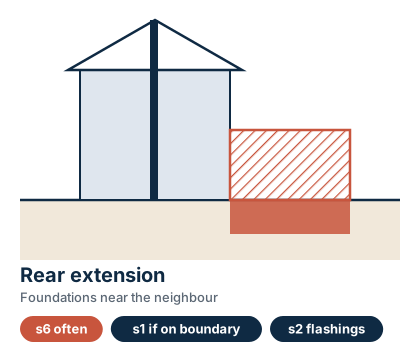
Rear extension: typical notices
Usually s6 for foundations; s1 if built on the boundary. Illustrative, not to scale.
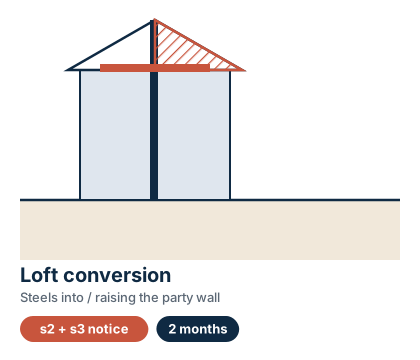
Loft conversion: typical notices
Usually s2 works under a s3 notice (2 months). Illustrative, not to scale.
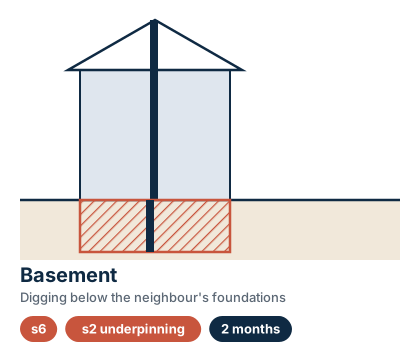
Basement: typical notices
Usually s6 plus s2 underpinning. Illustrative, not to scale.

Typical only. The 1-minute checker or a free call will confirm what applies.

Does the Party Wall Act apply to your project?

Tell us about your project and a local qualified surveyor from our team will confirm which party wall notices you need and your fixed fee. Nothing to pay until the work is done.

Free callGet a quote