Do I really need a party wall agreement?
Yes, if the work is notifiable, even when your neighbour is happy. The Act’s rights only apply once valid notice is served: no notice, no Act. A friendly neighbour makes the agreement quick and cheap, because they can simply consent in writing. Skipping notice leaves you exposed to injunctions, damage disputes and awkward questions when you sell.
What the “agreement” actually is
The Act does not use the phrase “party wall agreement”. It requires the building owner to serve notice. The adjoining owner then has 14 days to respond (s.5, s.6(7)). If they consent in writing, that consent is your agreement. If they dissent, or do not reply, a dispute is deemed to exist and surveyors make a Party Wall Award under s.10. Each neighbour is dealt with separately.
Works that need notice
| Type of work | Section | Notice period | Typical examples |
|---|---|---|---|
| New wall on or at the boundary | s.1 | One month | Extension or garden wall built on or against the line of junction |
| Work to an existing party wall or party structure | s.2, served under s.3 | Two months | Steel beams into the party wall, loft conversions, chimney breast removal, raising, thickening or underpinning, cutting in flashings |
| Excavation near a neighbour’s building | s.6 | One month | Foundations within 3 metres and deeper than the neighbour’s, or within 6 metres where a 45-degree line down from their foundations is cut |
Flats count too: floors and walls between flats in different ownership are party structures. Detached houses can still need section 6 notices for new foundations near a neighbour’s building.
Works that usually do not need notice
- Drilling for shelves, TV brackets, kitchen units and radiators.
- Minor chases for sockets and wiring, rewiring and replastering.
- Work that does not touch the party wall and involves no excavation within the 3 or 6 metre distances, such as most internal alterations, replacement windows and many rooflights.
The test is whether you are exercising one of the rights in sections 1, 2 or 6. If in doubt, use the check above or see section 2 rights explained.
What happens if you skip it
- No notice, no Act. Without a valid notice you cannot rely on the Act’s rights, and the neighbour can seek an injunction to stop notifiable work.
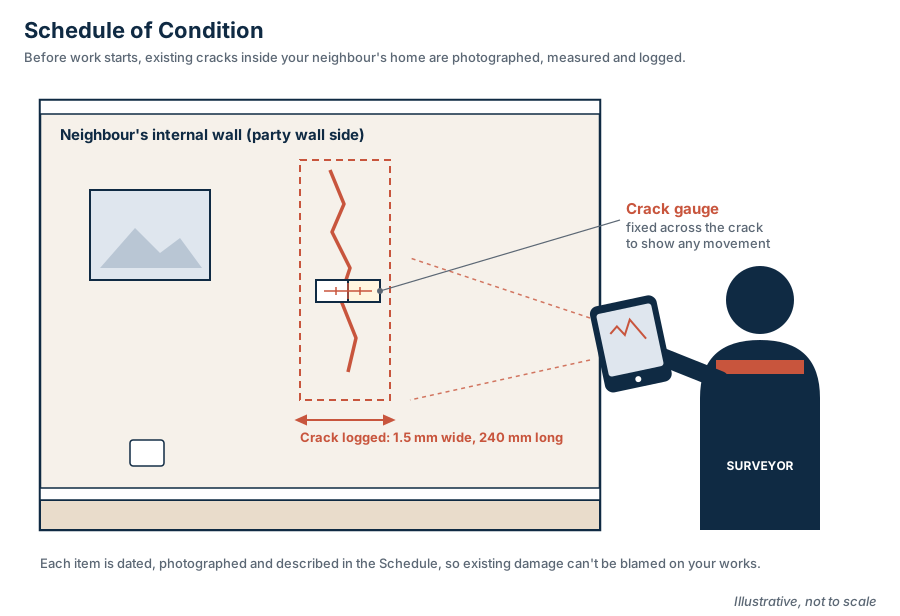
- Damage disputes. Without a Schedule of Condition it is hard to show what was already there, so arguments about cracks become expensive.
- Selling. Buyers’ solicitors ask about party wall notices, and missing paperwork can delay a sale. See selling during party wall works.
More detail: what happens if you start work without notice.
“Do I still need one if…?”
| Situation | Do I still need to serve notice? |
|---|---|
| I have planning permission or building control approval | Yes. Planning and building regulations are separate from the Party Wall Act. |
| My neighbour has said it is fine | Yes. Serve notice; they can then consent in writing. |
| I live in a detached house | Possibly, if you are excavating within 3 or 6 metres of a neighbour’s building. |
| The work is only on my side of the wall | Yes, if you are cutting into the party wall, for example for a steel beam. |
| I own a flat | Often. Floors and walls between flats can be party structures; see party walls and flats. |
| I live in Scotland or Northern Ireland | No. The Act applies in England and Wales only. |
How to get one
Serve notice on every owner at least two months before section 3 work and one month before section 1 or 6 work. We do this for all your neighbours for £150 + VAT, posting notices first class so they are deemed served the next day. If the neighbour consents subject to a Schedule of Condition, notices with a Schedule cost £499 + VAT. If there is a dispute, the full package with an Agreed Surveyor Award is £899 + VAT (£999 + VAT in London), with the Agreed Surveyor supplement of £50 currently waived. Fees are invoiced on completion. Step by step: how to get a party wall agreement.
More short answers: party wall agreement questions answered.
This guide is general information on the Party Wall etc. Act 1996, which applies in England and Wales. It is written from our surveyors’ practical experience and is not legal advice; for a specific dispute, take advice on your own facts.
Written by John Greenan AssocRICS, MFPWS, ACABE
Party wall and residential property surveyor with 25+ years’ experience in surveying and construction. Last reviewed 29 October 2026.
Sources: Party Wall etc. Act 1996 (legislation.gov.uk) · The Party Wall etc. Act 1996: explanatory booklet (GOV.UK). Last reviewed 29 October 2026. General guidance on the law in England and Wales, not legal advice.