
- I’ve been served a party wall notice. What do I do?
- How do I get a party wall agreement with a neighbour who is about to start works?
- Should I consent or dissent to a party wall notice?
- Who pays for my party wall surveyor?
- What is a Schedule of Condition and why does it protect me?
- My neighbour started work without serving a notice. What can I do?
- What if the works damage my property?
- How long do I have to respond, and what are the time limits?
I’ve been served a party wall notice: what do I do?
First, check which notice it is. A Section 1 notice covers a new wall on the boundary, a Section 3 party structure notice covers work to the shared wall itself (the work is listed in section 2, for example steel beams, raising the wall or removing a chimney breast), and a Section 6 notice covers digging foundations near your home. ss.1, 2, 3, 6
Then reply in writing within 14 days. Your choices are the four options above. Whatever you choose, it’s sensible to tell your neighbour before the 14 days run out; a short, friendly conversation goes a long way.
How do I get a party wall agreement with a neighbour about to start works?
In everyday use, a “party wall agreement” is either your written consent or, more formally, a Party Wall Award. To get an award, you dissent and appoint a surveyor. The surveyors (one Agreed Surveyor, or one for each owner who then select a third surveyor) settle the “dispute” by making an award s10(1), s10(10). The award sets out:
- what work will be done, how and when, including working hours;
- a Schedule of Condition of your property;
- access arrangements and protective measures;
- how any damage will be put right, and who pays the surveyors’ fees.
Consent or dissent?
Consent is quick, but leaves no record of your property’s condition. For relatively simple, straightforward works, consent subject to a Schedule of Condition still keeps the full protection of the Act and gives clarity for everyone; it’s the most popular choice. If extra matters need covering (working hours, access, further agreements), dissenting and appointing the Agreed Surveyor goes a step further with a full award. Where works are complex or relations are strained, it’s often better for each owner to appoint their own surveyor. Dissent doesn’t mean you object to the project, and it doesn’t stop your neighbour building. It means the work goes ahead under an award.
If you receive a Section 3 notice, you can also serve a counter-notice within one month asking for additional works for your benefit, such as deeper foundations or chimney copings s4.
Who pays for my surveyor?
The surveyors decide on costs under the Act, and the building owner normally pays the reasonable costs of the award, including your surveyor’s fees s10(13). So appointing your own surveyor, which can be us, usually costs you nothing. You’d only pay if you asked for work purely for your own benefit, such as counter-notice works.
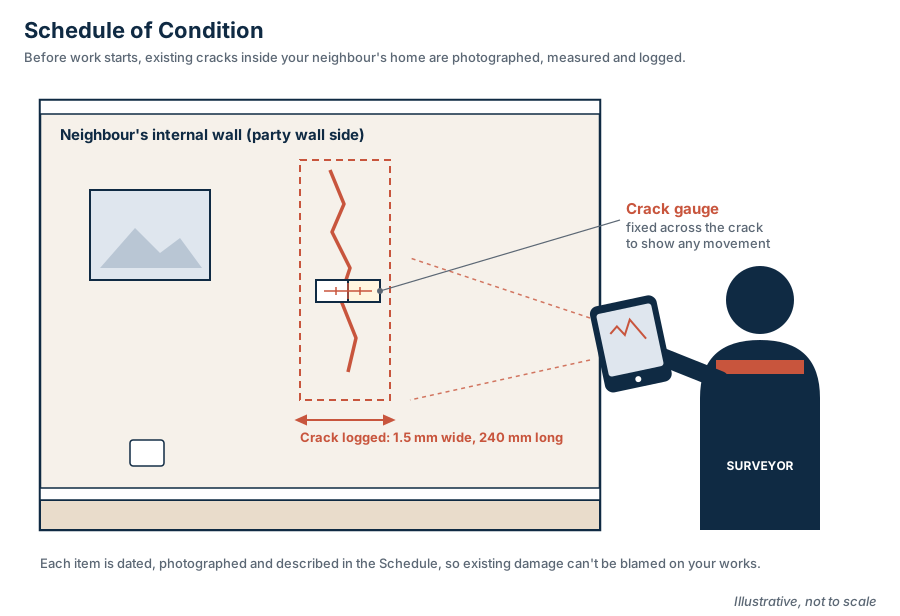
What is a Schedule of Condition and why does it protect me?
It’s a dated record of the parts of your home near the works, with written notes and photographs of existing cracks, finishes and defects. If new damage appears, it can be compared with the schedule, which avoids arguments about whether the damage was already there. On our projects we take thousands of photographs for these records.
Work started without notice
If notifiable work starts without a notice, the building owner is in breach of the Act. Ask them, politely and in writing, to stop and serve the correct notices. Take dated photographs. If they carry on, you can apply to the courts for an injunction to stop the work until the Act is followed. Take legal advice before doing so. We can contact the building owner for you, and in most cases that’s enough to get the process back on track.
Damage to my property
The building owner must compensate you for any loss or damage caused by the works s7(2). Under an award, the surveyors decide on the repairs. You can also ask for a payment instead of the building owner making good the damage, so you can use your own builder s11(8).
Timeframes at a glance
- 14 days to respond to a notice. With no reply, a dispute is deemed to have arisen s1(4) s5 s6(7).
- 10 days to appoint a surveyor after a request under s10(4); otherwise one is appointed for you.
- 1 month to serve a counter-notice to a Section 3 notice s4.
- 14 days to appeal an award to the county court s10(17).
- Notices lapse if the work hasn’t started within 12 months s3(2)(b), s6(8).
Source: Party Wall etc. Act 1996 (legislation.gov.uk). General guidance for England & Wales only, not legal advice.