
When section 2 applies
Section 2 applies where adjoining lands are built on at the line of junction, or there is a boundary wall there that is a party fence wall or the external wall of a building (s.2(1)). In other words, there is already something on the boundary. If the boundary is open, section 1 applies instead.
The rights apply to party walls, party structures (including floors between flats) and party fence walls as defined in s.20, and in some cases to the external walls of either owner built against them.
The section 2(2) rights, one by one
| Right | What it allows | Typical domestic example |
|---|---|---|
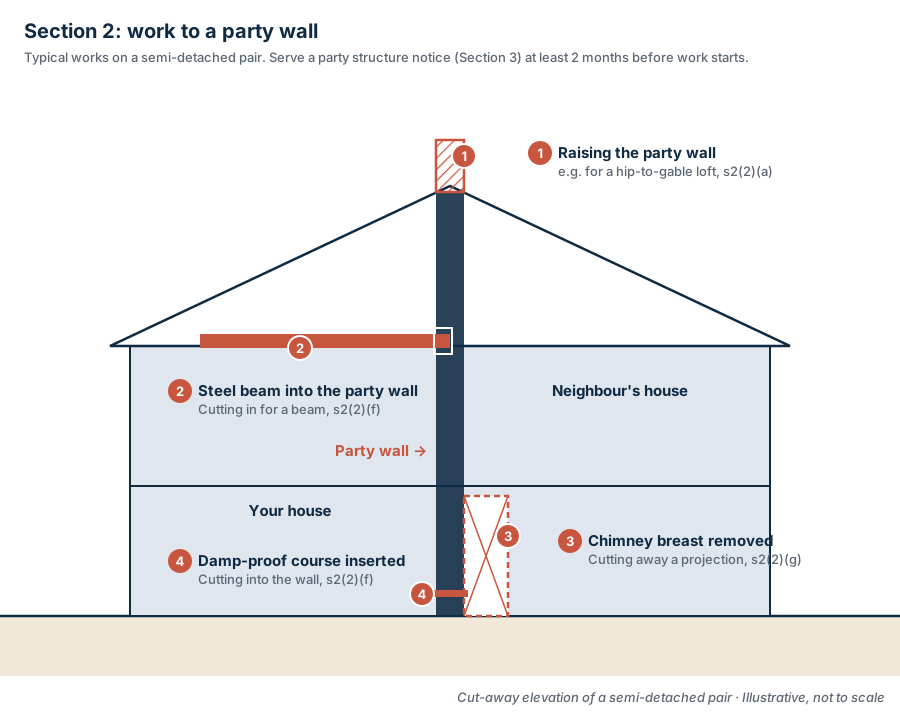
| (a) | Underpin, thicken or raise a party structure, party fence wall, or your own external wall built against one | Underpinning for a basement; raising the party wall for a loft or extra storey |
| (b) | Make good, repair, or demolish and rebuild a party structure or party fence wall that is defective or out of repair | Rebuilding a bulging garden wall; repairing a cracked party wall |
| (c) | Demolish a partition between buildings of different owners that does not conform with statutory requirements, and build a conforming party wall | Replacing a timber partition between two properties |
| (d) | Demolish and rebuild non-conforming buildings, arches or structures over public ways or others’ passages | Flying freeholds over a passage (rare) |
| (e) | Demolish a party structure of insufficient strength or height for the intended building and rebuild it | Rebuilding a party wall to take a new upper storey |
| (f) | Cut into a party structure for any purpose, including inserting a damp-proof course | Steel beam bearings, padstones, deep chases, injected DPC |
| (g) | Cut away footings, chimney breasts, jambs, flues or other projections from a party wall, party fence wall, external wall or boundary wall | Chimney breast removal; trimming a projecting footing |
| (h) | Cut away parts of the neighbour’s wall or building overhanging your land or the party wall, to build or raise a vertical wall | Cutting back overhanging eaves or a gutter to raise a wall |
| (j) | Cut into the neighbour’s wall to insert a flashing or weather-proofing for a wall built against it | Flashings to an extension roof or raised wall |
| (k) | Other necessary works incidental to connecting a party structure with adjoining premises | Tying in new work |
| (l) | Raise a party fence wall, or raise it for use as a party wall; demolish and rebuild a party fence wall | Building an extension wall up off a shared garden wall |
| (m) | Reduce, or demolish and rebuild, a party wall or party fence wall to a lower height (subject to limits and s.11(7)) | Lowering a tall garden wall to 2 m |
| (n) | Expose a party wall or structure previously enclosed, providing adequate weathering | Demolishing an attached outbuilding, leaving the wall exposed |
There is no paragraph (i) in the Act. The full text is on legislation.gov.uk.
The conditions attached to the rights
The rights are not unconditional. The Act attaches specific duties:
- Raising, thickening or underpinning (a), where not needed for repair: you must make good all damage to the neighbour’s premises, internal furnishings and decorations, and carry up their flues and chimney stacks that form part of or rest on the wall, to a height and in materials agreed or determined by the surveyors (s.2(3)).
- Demolishing and rebuilding a structure of insufficient strength (e): the same make-good and flue duties (s.2(4)), plus a fair allowance for disturbance if the neighbour’s premises are laid open (s.11(6)).
- Cutting in, cutting away and cutting overhangs (f), (g), (h): make good all damage to the neighbour’s premises, furnishings and decorations (s.2(5)).
- Flashings (j): make good all damage to the neighbour’s wall (s.2(6)).
- Reducing height (m): reconstruct or provide a parapet where needed (s.2(7)).
Over and above these, every right is subject to the general duties in section 7: no unnecessary inconvenience, compensation for any loss or damage, protection where premises are laid open, and keeping to the agreed plans.
Who pays for the work
The general rule is that the building owner pays (s.11(1)). The exceptions are where work is needed because the wall is defective or out of repair, under rights (a) or (b), when the cost is shared in proportion to use and responsibility for the defect (s.11(4)–(5)); and where the neighbour asks for extra work for their own benefit, which they pay for (s.11(9)). If the neighbour later makes use of work you paid for, such as building onto a wall you raised, they pay a due proportion (s.11(11)).
How section 2 relates to section 3
Section 2 gives the rights; section 3 says how to use them. Before exercising any section 2 right you must serve a party structure notice at least two months before work starts, giving your name and address, the nature and particulars of the work and the start date. If special foundations are proposed, plans, sections and load details are required too. See our section 3 guide.
What is generally not section 2 work
The government booklet treats minor work such as drilling to fix shelves, kitchen units or sockets, and replastering, including minor chases for sockets and wiring, as not notifiable. Anything that cuts into the wall structurally (beam pockets, removing bricks) is s.2(2)(f). Work that is wholly on your own side of a wall you own outright is not party wall work at all, although section 6 might still apply to excavation.
Worked example: one project, several rights
Illustrative only. Ravi is extending his semi-detached house to the rear and into the loft. The new kitchen beam bears in the party wall (f). The redundant chimney breast on the party wall in the back bedroom comes out (g). The party wall is raised 900 mm in the roof space to carry a dormer cheek (a), and his neighbour’s flue in that wall must be carried up as a result (s.2(3)). A flashing is cut into the neighbour’s raised wall where the dormer roof meets it (j). One party structure notice lists all of these, with the engineer’s drawings. The Award records the condition of the neighbour’s house, the method for each element, and the extension of the neighbour’s flue at Ravi’s cost.
Practical tips
- List every section 2 element in the notice. A notice that says “loft conversion” with no particulars invites dissent and can be challenged as invalid.
- Have the engineer’s drawings ready. Bearing details, padstones and temporary works are what surveyors check.
- Check for shared flues and chimney stacks before you design around them.
- If your builder wants to add something mid-job, such as an extra beam or chase, it needs to be agreed or covered by a further notice or addendum (s.7(5)).
Sources and further reading
- Party Wall etc. Act 1996, section 2: Repair etc. of party wall: rights of owner (legislation.gov.uk)
- Party Wall etc. Act 1996, section 3: Party structure notices (legislation.gov.uk)
- Party Wall etc. Act 1996, section 7: Compensation etc. (legislation.gov.uk)
- Party Wall etc. Act 1996, section 11: Expenses (legislation.gov.uk)
- Party Wall etc. Act 1996, section 20: Interpretation (legislation.gov.uk)
- GOV.UK: The Party Wall etc. Act 1996 explanatory booklet
- GOV.UK: Party walls and building work
Section references are to the Party Wall etc. Act 1996 as it applies in England and Wales, checked against legislation.gov.uk. This guide is general professional guidance, not legal advice; every project should be assessed on its own drawings.
- Party wall notices for building owners
- Fixed fees: party wall agreement cost
- Do I need a party wall agreement? (1-minute check)
Areas we cover include Party Wall Agreement Hertfordshire · Party Wall Agreement Surrey · Party Wall Agreement Sussex and more.
Sources: Party Wall etc. Act 1996 (legislation.gov.uk) · The Party Wall etc. Act 1996: explanatory booklet (GOV.UK). Last reviewed 27 October 2026. General guidance on the law in England and Wales, not legal advice.